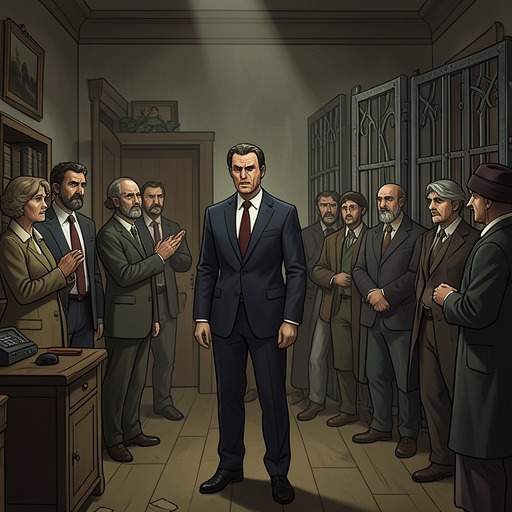
Aldo Finzi
M: Son of the CenturyAldo Finzi’s career links Fascist political access with the movement’s reliance on personal intermediaries. An aviator decorated for flying over Vienna alongside Gabriele D’Annunzio, he became a channel between Benito Mussolini and other political actors during the approach to power. Later, his position as undersecretary of the interior and his proximity to Mussolini’s circle placed him inside networks that mixed official authority, political loyalty, and concealed operations. The Matteotti crisis turned that access into a liability: Finzi was suspected, pressed to resign, and then frightened away from making public accusations.
Identity and Background
The account introduces Finzi as an aviator, pilot, and motorcyclist who loved speed. He was the son of a prosperous industrialist of Jewish origins from Polesine, the same region as Giacomo Matteotti. That shared regional background did not make the two men political allies. Finzi is described as hating the impoverished peasants who hoped for a Bolshevik revolution, placing him on the side of those who feared radical social change rather than those demanding it.
His military record and personal connections gave him a distinctive place in the emerging Fascist milieu. During the Great War, he received a gold medal for valor for flying over Vienna with D’Annunzio. The flight joined the two men in a conspicuous act of wartime audacity; in the later political narrative, that association helped make Finzi a credible emissary between the poet-warrior and Mussolini. His identity therefore rests on more than a public office: it combines a decorated military past, a family background connected to industry, and access to political leaders who could use him as a go-between.
Political Access and the Fiume Connection
Finzi’s role as an intermediary becomes visible in Mussolini’s attempts to draw D’Annunzio into his political plans. Mussolini sent Finzi to approach him after an earlier proposal had involved a government with Francesco Saverio Nitti and Vittorio Emanuele Orlando. D’Annunzio received Finzi but imposed conditions: no attack on workers’ organizations and no money from industrialists or agrarians. The restrictions reveal the limits of the approach. Finzi could carry an offer and open a conversation, but he could not erase the conflict between D’Annunzio’s demands and the political alliances around Mussolini.
The rivalry became sharper as Mussolini prepared his own March on Rome. On October 24, Tom Antongini went to invite D’Annunzio to flank the march. The narrative presents the proposal as an affront to the poet-warrior, who had imagined a march on Rome since the days of Fiume and believed that Mussolini had appropriated the movement’s songs, mottos, and salutes while discarding its ideals. Finzi’s earlier mission belongs to this same effort to engage D’Annunzio, but the later approach through Antongini demonstrates that the initiative remained Mussolini’s and that Finzi’s personal connection could not settle the rivalry.
A brief telephone exchange also places Finzi within the communications surrounding these political maneuvers. In it, a speaker says that Finzi is present and wants to talk; the response is to put him on. The passage does not identify the substance of the exchange, but it reinforces the practical function attributed to him elsewhere: he was someone through whom leaders could reach one another, not merely a name attached to a formal title.
The March on Rome and Governmental Power
During the crisis in October 1922, Finzi was again used as a channel between Milan and Rome. Luigi Federzoni called while Luigi Facta was meeting the king over the state-of-siege decree. Mussolini declined to take the call, and Finzi answered while Cesare Rossi listened on another headset. Federzoni’s position was politically ambiguous: he was close to the king, led the nationalist movement whose blue shirts were defending Rome, and was also sympathetic to the Fascists preparing to attack it.
Finzi told Federzoni that he would inform Mussolini and raised a practical objection about military orders from Milan: the movement could not distance itself from the Fascist organization and begin shooting at it. This exchange shows him working at a point where political coordination confronted the possibility of military force. Mussolini then told him to keep the leader informed, communicate with Perugia, and confirm that the movement was serious throughout Italy. In a further instruction, Mussolini said that he deferred to whatever the commanders decided. Finzi thus carried messages while the movement’s leaders balanced political pressure against decisions being made by military authorities.
The governmental crisis moved quickly around these exchanges. Facta resigned after meeting the king, judging that an earlier resignation might have allowed a government capable of confronting the Fascist threat, while a resignation at that moment would leave the country without one. Later, when Alfredo Rocco came to persuade Mussolini to support an Antonio Salandra government, Mussolini gave him a list of ministers and insisted that no solution was possible without his own inclusion. These developments clarify the stakes of Finzi’s communications: he operated amid the collapse of the existing government and Mussolini’s insistence on becoming part of its replacement.
Office, Patronage, and Political Networks
After the March on Rome, Finzi’s access took on an official dimension. The narrative identifies him as undersecretary of the interior and says that he exploited this position in connection with the surplus-goods business that helped finance the march. Others named in the same account included Emilio De Bono, who as police chief should have been alert to fraud, and Cesare Rossi. It also describes Amerigo Dùmini as protected by Rossi and brought into the prime minister’s office to handle what the new power called dirty operations: attacks on dissidents carried out in the shadow of the state. The account connects Finzi to the broader political and financial network, but does not say that he directed or carried out those assaults.
Mussolini’s circle depended on trusted collaborators as well as formal institutions. At a later public appearance, he mocked the claim that he was merely a good dictator controlled by bad advisers, saying his decisions matured in solitude while a small group brought him information about Italy and shared responsibility for the Fascist government. The passage associates this circle with figures including Francesco Giunta, De Bono, Rossi, and Finzi. Separately, on January 10, Rossi, Giunta, Giovanni Marinelli, and De Bono met at Mussolini’s residence and decided to form a secret unit under their supervision to act against the movement’s enemies, because they considered existing law inadequate to the transition they sought. Finzi is not listed as attending that meeting; the distinction matters. His place in the circle does not establish participation in every operation it undertook.
The Matteotti Crisis and Finzi’s Retreat
The disappearance of Giacomo Matteotti brought Finzi’s political position under direct pressure. As false reports and accusations circulated, Finzi, a Fascist deputy from Rovigo, became one of the suspects. Mussolini later received Velia Matteotti with senior officials beside him, including Finzi. The scene places him close to the center of the government’s response, at a moment when the missing man’s case was drawing attention toward the regime and its associates.
Mussolini then asked Finzi and Rossi to resign, seeking to break the chain of responsibility before it reached him. Finzi initially agreed, but afterward contacted the newspaper Corriere della Sera and threatened revelations. He claimed that the crime’s mastermind was Mussolini alone and invoked his own honor and service to the country. The threat marked a sharp reversal: the former intermediary was no longer simply transmitting the leader’s instructions but suggesting that he could expose the leader’s responsibility.
That confrontation did not last. After meeting Mussolini on June 16, Finzi left looking pale and agitated and said he regretted his movement toward the opposition. Mussolini had promised to reinstate him once he became arbiter of the situation. The account presents Finzi as frightened and his threat as withdrawn, not as a disclosure that resolved the case. His trajectory ends in compromised proximity: the same access that had enabled him to serve as emissary and officeholder now made him vulnerable, yet the promise of renewed position drew him back from open defiance. In his story, influence is real but conditional, sustained by closeness to power and narrowed when that power is threatened.